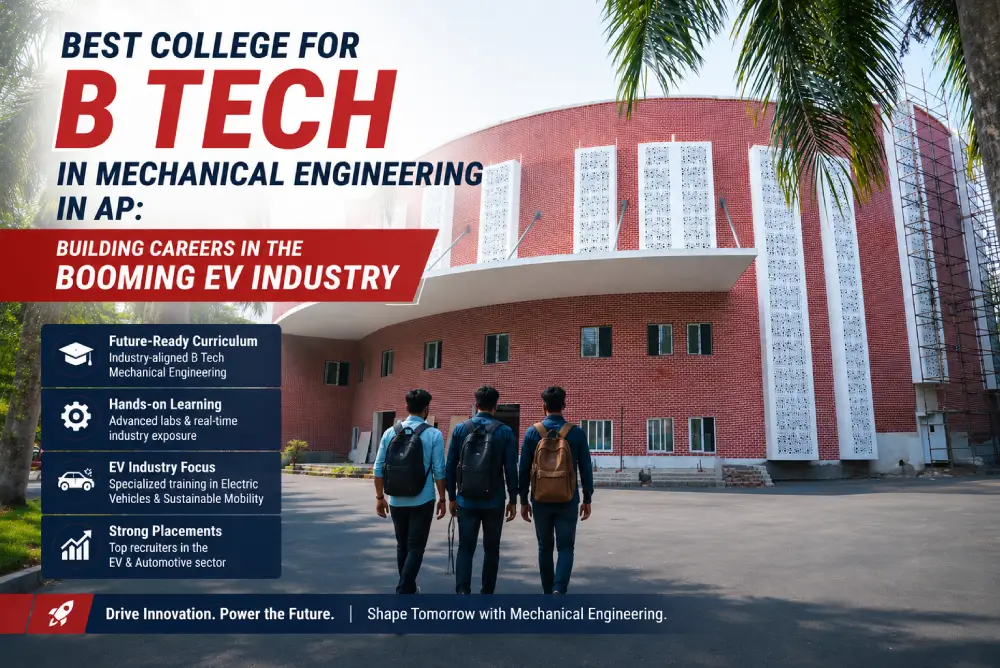
Best College for B Tech in Mechanical Engineering in AP: Building Careers in the Booming EV Industry
Finding the best colleges for B Tech in Mechanical Engineering in AP matters more in 2026 than it has in years. Andhra Pradesh is now one of India’s serious manufacturing and electric vehicle hubs. Kia, Isuzu, Hero MotoCorp, Apollo Tyres and a thick web of auto component makers all run operations here. That single fact changes the value of a mechanical degree earned in this state. You study close to the factories, the recruiters and the jobs.
Mechanical engineering is not the fading branch people warned about a decade ago. It came back stronger, rebuilt around electric vehicles, smart factories, robotics and clean energy. The right college turns that opportunity into a real career. The wrong one leaves you with a degree and no edge. This guide breaks down what modern mechanical engineering courses really involve today, what the careers and salaries look like, and how to pick a college that actually prepares you. Throughout this guide we will use GMR Institute of Technology (GMRIT) in Rajam, Andhra Pradesh as a working example. GMRIT, Deemed to be University, runs its four-year B.Tech in Mechanical Engineering under its School of Applied Engineering, with an intake of 120 students and a focus on design, manufacturing and thermal systems engineering.
Quick Overview: Mechanical Engineering at a Glance
Before we go deep, here is the whole picture in one table. Skim it, then read the sections that matter to you.
| Aspect | What You Should Know |
|---|---|
| Topic Overview | B Tech covering design, thermal systems, manufacturing, robotics and electric mobility |
| Industry Relevance | Core of automotive, EV, aerospace, defence, energy and heavy manufacturing |
| Career Opportunities | Design engineer, EV powertrain engineer, automation specialist, manufacturing lead, R&D engineer |
| Required Skills | CAD/CAM, simulation, thermodynamics, materials, automation, basic data skills |
| Academic Pathways | B Tech, M Tech, MS abroad, MBA, PhD, GATE-based PSU routes |
| Future Scope | Strong, pushed by EVs, Industry 4.0, robotics and clean energy |
| Industry Demand | Rising, as Make in India targets a 25% manufacturing share of GDP by 2030 |
| Salary Potential | Freshers around 3 to 4.5 LPA, specialists crossing 20 to 60 LPA |
| Higher Education | M Tech, research fellowships, foreign MS, management degrees |
| Research Opportunities | EV systems, additive manufacturing, thermal engineering, smart materials |
Why Mechanical Engineering Is Booming Again
Let us clear up the biggest myth first. People kept saying software would make mechanical engineering useless. It did the opposite. The branch reinvented itself around the things the world now wants most: clean transport, automated factories and sustainable energy.
India’s electric vehicle market was worth roughly US$3.7 billion in 2025, and IBEF projects it will climb toward US$191 billion by 2034. That is a growth rate above 50 percent a year. The sector is expected to add about 500,000 new jobs by 2030. A large share of those are mechanical roles, from vehicle design and battery cooling to manufacturing and component engineering. This is exactly the demand that programs like the one at GMRIT Deemed to be University are built to feed.
Industry Applications and Real-World Use Cases
Mechanical engineering touches almost everything physical around you. Right now, the fastest growth runs through electric mobility and modern manufacturing. Many students lean into a focused track here, whether that is an automobile engineering course, a manufacturing engineering degree, or mechanical design engineering for product development.
- Electric vehicles: powertrain design, motor mounting, battery cooling, lightweight chassis and crash safety.
- Advanced manufacturing: robotic assembly, 3D printing, CNC machining and lean production.
- Aerospace and defence: propulsion, structures and materials for the DRDO, HAL and BEL ecosystem.
- Energy and sustainability: wind turbines, solar mounting, hydrogen systems and energy storage.
- Robotics and automation: motion control, mechatronics and smart factory systems.
Emerging Trends Shaping Mechanical Careers
The smart move is to align your skills with where the field is heading, not where it has been. GMRIT Deemed to be University keeps its mechanical curriculum NEP-aligned and adds emerging technology electives, so students can move toward these areas instead of being stuck on a fixed, dated syllabus.
| Trend | Why It Matters | Skill To Build |
|---|---|---|
| Electric Mobility | EV market growing above 50% a year | Powertrain and thermal design |
| Industry 4.0 | Connected, smart factories | IoT, sensors, data basics |
| Additive Manufacturing | Faster, complex parts | 3D printing, design for AM |
| Digital Twins | Test products virtually | Simulation, CAE tools |
| Sustainable Engineering | Net-zero targets | Materials, life-cycle design |
| Robotics and Mechatronics | Automation everywhere | Control systems, coding |
Career Scope and Salary Potential
Mechanical engineering careers pay steadily and scale well over time. It is often called the mother branch of engineering because its graduates fit so many industries.
| Career Stage | Typical Role | Indicative Salary (India, 2026) |
|---|---|---|
| Fresher | Production, design, quality, maintenance | 3 to 4.5 LPA, top candidates higher |
| Mid Level (5 to 8 yrs) | Senior design, project, R&D | 8 to 20 LPA |
| Senior Specialist | Automation, aerospace, energy leadership | 25 to 60 LPA |
| Global Roles | USA, UAE, Germany positions | Often premium pay |
Engineers who pair core mechanical skills with automation, data or sustainability knowledge earn roughly 30 to 50 percent more than peers with theory alone. So the degree opens the door, but the extra skill sets your pay. GMRIT reports a highest package up to 37 LPA and 1200+ placements for the 2026 batch, with 100+ companies visiting campus.
Academic Curriculum and Higher Education Pathways
A future-ready B Tech balances strong basics with electives in growth areas. Under the National Education Policy 2020, good colleges offer flexible, choice-based learning, the backbone of any industry-focused mechanical program. That lets you lean toward EV systems, robotics or manufacturing instead of one fixed track.
| Year | Focus | What You Gain |
|---|---|---|
| Year 1 | Basics, maths, mechanics | A solid foundation |
| Year 2 | Thermodynamics, materials, manufacturing | Core competence |
| Year 3 | Design, CAD/CAM, electives, internships | Real industry exposure |
| Year 4 | Specialisation, project, placements | Job or higher-study readiness |
After your degree, the road splits in useful ways. M Tech for technical depth. MS abroad for global exposure. MBA for management. GMRIT fits this picture cleanly. Its B.Tech in Mechanical Engineering is a four-year programme with an intake of 120 under the School of Applied Engineering, built on an NEP-aligned, flexible structure. Because GMRIT is a Deemed to be University offering B.Tech, M.Tech and Ph.D levels, you can also continue your higher studies on the same campus.
How To Choose the Best Colleges for B Tech in Mechanical Engineering in AP
The best colleges for B Tech in Mechanical Engineering in AP combine an NEP-aligned, industry-focused curriculum, modern labs, a genuine research culture, steady placements with strong recruiters, and closeness to the state’s automotive and EV manufacturing hubs.
Use this checklist when you compare colleges. Print it if you have to.
| Factor | What To Look For |
|---|---|
| Accreditation and Status | Autonomous or deemed university status, recognised rankings |
| Curriculum | NEP-aligned, EV and automation electives, flexible credits |
| Labs | CAD/CAM, simulation, manufacturing and EV-relevant facilities |
| Placements | Number of offers, recruiter quality, highest and median packages |
| Research | Faculty publications, h-index, funded projects |
| Industry Links | Internships, live projects, MoUs with manufacturers |
| Location | Closeness to auto and EV clusters for exposure and jobs |
Where GMRIT Stands Among the Top Mechanical Engineering Colleges in AP
GMRIT Deemed to be University has spent more than twenty-eight years turning curious students into industry-ready engineers. It is backed by the GMR Group and ranked in the Times Higher Education Asia Rankings, which puts it firmly among the best engineering colleges Andhra Pradesh has to offer. For a mechanical aspirant, the things that matter line up well here, and the strong mechanical engineering placements record is a big part of why GMRIT Deemed to be University earns a place on any serious shortlist.
| GMRIT Strength | The Detail |
|---|---|
| Academic Excellence | 28+ years of excellence, recognised among India’s leading engineering institutions |
| Governance | Autonomous status from UGC in 2012, autonomy extended until 2028 without a committee visit |
| Research Impact | Research-driven ecosystem with an h-index of 71 |
| Placements | 1200+ placements for the 2026 batch (ongoing), 100+ companies on campus, highest package up to 37 LPA |
| Curriculum | NEP-aligned flexible curriculum with emerging technology programmes |
| Faculty and Scale | 300+ faculty members, 5000+ students |
| Alumni Network | 13200+ alumni across industry and academia |
| Global Exposure | International opportunities and industry-integrated learning |
Frequently Asked Questions
1. What are the best colleges for B Tech in Mechanical Engineering in AP?
The top mechanical engineering colleges in AP mix NEP-aligned courses, modern labs, real research and steady placements. GMRIT, with 28+ years of excellence, an h-index of 71 and packages up to 37 LPA, is among the strong choices.
2. Is mechanical engineering still in demand in 2026?
Yes. EVs, Industry 4.0, robotics and clean energy keep demand high. Engineers with automation and data skills earn roughly 30 to 50 percent more than peers.
3. What is the starting salary for a mechanical engineer in India?
Freshers usually earn around 3 to 4.5 LPA, with top candidates higher. Specialists in automation, aerospace and energy can cross 25 to 60 LPA with experience.
4. How does mechanical engineering connect to the EV industry?
Mechanical engineers design EV powertrains, manage battery cooling, build lightweight chassis and run manufacturing lines, so they sit at the centre of electric mobility.
5. What skills should a mechanical engineering student learn?
Learn CAD tools like SolidWorks and CATIA, simulation tools like ANSYS and MATLAB, manufacturing methods, and modern skills in IoT, robotics and data analytics.
6. What can I study after B Tech in Mechanical Engineering?
You can pursue M Tech, MS abroad, MBA, PhD or GATE-based routes into PSUs and research, based on whether you want depth, management or research.
7. Why choose a college in Andhra Pradesh for mechanical engineering?
AP hosts makers like Kia and Isuzu, a dense auto ancillary network and an active EV policy, which gives students real exposure and jobs close by.
8. What placements does GMRIT offer for mechanical engineering students?
GMRIT reports 1200+ placements for the 2026 batch with 100+ companies on campus and a highest package up to 37 LPA, backed by industry-integrated learning.
9. Is GMRIT an autonomous institution?
Yes. GMRIT got autonomous status from UGC in 2012, and its autonomy was extended until 2028 without a committee visit, which reflects strong governance.
10. What is the future scope of mechanical engineering?
The future scope is strong, driven by EVs, smart manufacturing, robotics and renewable energy, with India targeting a 25 percent manufacturing share of GDP by 2030.
Conclusion
Mechanical engineering is not slowing down. It is powering the biggest industrial shift of our time, and Andhra Pradesh sits close to the heart of it. So choosing among the best colleges for B Tech in Mechanical Engineering in AP is really a choice about your future. Do you want to read about the EV revolution, or help build it? GMRIT gives you a place where strong basics meet modern tools, where research is real and where placements turn study into paychecks.
Read Next

Best Deemed University in Andhra Pradesh: Why GMRIT DU, Rajam...